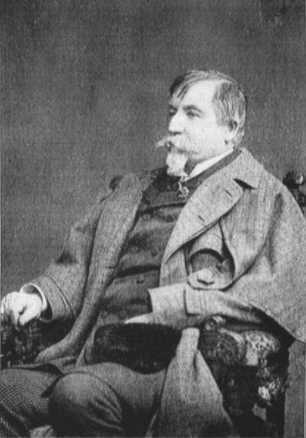
Inspector General of the Union Army and early landowner on the west side of Downers Grove.
Early Life
Arthur Charles Ducat was born on February 24, 1830, into a well-off family in Kingstown (now Dún Laoghaire), County Dublin, Ireland. In 1842, when he was still a teenager, his father passed away, leaving many debts. This changed his life entirely. He was sent to apprentice as a merchant, but found he was ill-suited for the profession and went back to school for civil engineering. Money was needed to support his family, so at 15, he joined the military.
An unexpected growth spurt was so difficult on his body and health that he was labeled infirm and released from his military service in Ireland. He immigrated to Chicago, Illinois in 1851, where he worked as a Civil Engineer and Insurance Agent.
Move to Chicago
Ducat worked out of Chicago for years surveying for the C,B &Q railroad that would eventually come to Downers Grove in 1864. His surveying efforts ultimately led to the line coming through the heart of Downers Grove.
Civil War Service
He joined the Illinois 12th Infantry as a 2nd Lieutenant on May 2nd, 1861, when he was 31 years old. This higher starting rank was possibly influenced by previous service in Ireland and standing in the community. His volunteer position was only supposed to last 3 months, but he stayed till the end of the war. He was named Adjutant after being in the service for just 9 days. He was promoted remarkably fast within the military ranks. The Adjutant generally assists commanding officers with unit administration. That same day he was promoted to the rank of 1st Lieutenant, four months later he was promoted again, this time to the rank of Major. He was promoted again just 7 months later to Lieutenant Colonel.
He was the first Union officer injured at the Battle of Fort Donelson. A bullet winged him and knocked him off his horse. His own writings mention how this incident had been blown out of proportion. He was technically mustered out of service after this incident but stayed on as an Inspector General for two major federal armies. After the war ended, in 1866, President Andrew Johnson nominated Ducat for appointment to the Brevet grade of Brigadier General of volunteers. This went through and he was an honorary one-star general from that point on.
Lindenwald Estate
In 1872, a group of Chicago businessmen headed by General Arthur C. Ducat, purchased 800 forested acres west of Main Street in Downers Grove known as Linden Heights. He named has lands Lindenwald Estate. Gen. Ducat built his home in 1872 at the center of his lands, which allowed him to live as a part-time country gentleman. He invited his mother and sister to come live with him there. His vast lands included what is now Denburn Woods, Gilbert Park and Maple Grove Forest Preserve.
He was fond of horses and dogs, raising both at his Lindenwald Estate home. He even gifted what he deemed a particularly excellent dog named Brow to General Sheridan. The dog travelled to Washington D.C. without accompaniment. A letter of thanks arrived shortly, letting Ducat know that Brow had arrived safely at the Sheridan home, stating Brow was in fact a very good boy and General Sheridan and his family were beyond happy with the gift.
National Guard Service during the Panic of 1873
During the Panic of 1873, the funds for the National Guard were lacking. Militiamen were expected to pay dues for their armory buildings, pay for their own uniforms, and they had no time off work for drills/military duty. Weapons were sometimes provided, but were often obsolete or damaged. Also, ammunition was lacking. The looming fears of an uprising amongst workers made state government agencies begin to rethink the lack of funding and organizational issues. The advice of General Ducat was sought out. While he lived in Downers Grove, he worked in Chicago and had property there as well.
The military code and present systems organization of the Illinois National Guard is the product of his brain. He was made their Major General and Commander. This included providing armories for National Guard members, Uniforms, and Compensation for time needed away from work for military purposes.
The Panic of 1873 was a trigger point for the economic implosion of capitalist ventures such as railroads and ended up ruining many banks across the country. It began with a waffling economy overseas, and many investors decided to pull their money out of the railroad systems in America. This had a domino effect and took out many railroad companies and their banking partners. People panicked and thought all the money in the banks would be gone, so they began to try to get all their money out of the banks, much like in the crash of 1929. The country fell into the worst financial depression ever seen by our nation to that point for the next 5 years. Due to financial difficulties, unemployment rates surged to over 14%. In an effort to make back some of the lost money, industrial employers started making workers work more hours for decreasing wages. There were no unions yet, and workers had no protection against these unfair labor practices. Communist parties began to form within the ranks of these workers. This came to a head in 1877 when striking workers clashed with both police and National Guard members. The riots took three days to stop, but General Ducat and his forces were told to stand down for the first two days by the Mayor of Chicago. Once they permission was granted, they were able to get things under control quickly. There were an estimated 30 deaths amongst protesters and over 200 injuries. However, when asked about this the police commissioner at the time said he thought there were at least 50 to 60 deaths but only 30 were officially counted.
His life in the 1880’s
In 1883 General Ducat hired architect William Le Baron Jenney, who he met during the Civil War, to design the Home Insurance Building in Chicago. The building was completed in 1885. This is the world’s first skyscraper, meager as it would appear to us now, being that it was only 10 stories high. Ducat was still the acting head of the western office of N.Y. Home Insurance Company at this time.
By this point General Ducat owned about 800 acres of property in D.G. He wanted D.G. to become a model town which others around the nation might strive to emulate. And he had plans to accomplish this dream of his. General Ducat began to subdivide his lands planning to build a subdivision of sorts. He proposed putting in a water system for the whole village if only people would get rid of their front yard fences. The Village turned down Ducat’s offer. Oddly enough, that same year a very simple sewer system was installed around town.
General Ducat sold 700 acres for $300 per acre, totaling $210,000. He kept 100 acres for his own family to use and preserve the natural landscape.
Death and Legacy
General Ducat died of pneumonia at his estate in Downers Grove, Illinois on January 29, 1896. In his death announcement, it is stated that no one thought he was going to die. He had been faring well and took a turn for the worse quickly.
Though General Ducat did so much for the military, both federally and at the state level, he requested his funeral to have none of the usual pomp associated with a military funeral.
His remaining land was left to his wife. She then signed most of them over to the state to become a Forest Preserve, protecting the natural landscape her husband and she loved so much. Some of the Marshall Field’s land was also signed over to DuPage County for its preservation. You may be familiar with these combined lands; they are now called Maple Grove Forest Preserve.