
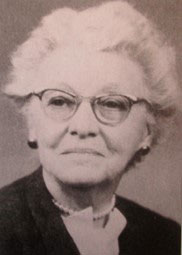
Lottie O’Neill was the first woman elected to the Illinois General Assembly, where she served for 40 years. When she retired, she was the longest-tenured female elected official in the United States.
Before the Capitol: A Life at Home
On June 13, 1904, Lottie Holman married Irish immigrant William Joseph O’Neill (1875–1925). Along with their two sons, they moved to Downers Grove in 1908 where they raised their family. Lottie devoted herself to civic and volunteer work, serving in the Red Cross, Campfire Girls, Downers Grove Women’s Club, and President of the Parent Teachers Association.
Widowed in 1925 at midlife, Lottie faced the loss of her husband with resilience and determination. Despite personal loss, she continued to raise and guide her family.
Elmer Holman O’Neill (1905–1963), Lottie’s oldest son, married Stella Martha “Peggie” Babin (1907–1989). They had two daughters. Stella was remembered on her gravestone as “A Gentle Soul, Wife, Mother, Grandmother, Jazz Pianist and Writer,” was buried at Oak Crest Cemetery in DuPage County. Elmer died unexpectedly while traveling, passing away at an airport in Atlanta.
Her younger son, William Jerome O’Neill (1906–1953), died in Australia. He never married.
Both of Lottie’s sons died while traveling, each under tragic circumstances that deeply marked the family’s history.
Trailblazer in Illinois Politics
It was her husband who encouraged Lottie to enter politics. So in November of 1922 she ran for the Illinois State Legislature. She believed women should have a place in politics in order for their voices could be heard. In 1922, just two years after the ratification of the 19th Amendment granted women the right to vote nationwide, Lottie Holman O’Neill made history as the first woman elected to the Illinois General Assembly. On January 3, 1923, she took her seat in Springfield, escorted by 1000 women who took a special train from Union Station for the event. A bathroom, affectionately called “Lottie’s Potty”, was built for her since she was the one and only woman serving in the Illinois General Assembly.
Lottie’s career would last 38 years. She served 13 terms in the House of Representatives and was elected 3 times to the State Senate. During that time she fought for bills to fund schools for disabled children, 8-hour workdays for women, and the right for women to serve on juries.
Legislative Accomplishments
Throughout her career, Lottie worked on a wide range of issues affecting women, families, and the broader public:
- Workplace Reform: She supported legislation establishing an eight-hour workday for women, reflecting early efforts to improve labor protections.
- Jury Service Equality: She played a key role in advancing legislation that allowed women to serve on juries in Illinois — a major milestone in civic equality.
- Support for Children with Disabilities: She advocated for improved state funding and services for children with disabilities, strengthening public responsibility for education and care.
- Fiscal Policy and Government Reform: In later years, she became known for her strong positions on fiscal responsibility and constitutional governance.
Lottie was widely respected for her independence, determination, and longevity in office. Her career bridged eras — from the early days of women’s suffrage through mid-20th-century political change. At the time of her retirement, she was the longest-serving female elected official in the United States.
Legacy
At a time when women in public office were exceedingly rare, Lottie stepped forward and won election on her own merit — opening the door for generations of women in Illinois politics.

Her contributions to Illinois are formally recognized today. A statue of her stands in the rotunda of the Illinois State Capitol in Springfield, honoring her groundbreaking service. Closer to home, O’Neill Middle School in Downers Grove bears her name, ensuring that new generations learn about her historic role in shaping state government.
Lottie Holman O’Neill’s legacy is one of perseverance and leadership. As the first woman elected to the Illinois legislature, she not only made history — she helped change it. Lottie Holman O’Neill died on February 17, 1967, and was laid to rest at Oak Crest Cemetery in Downers Grove. Her life reflects the resilience of a woman who endured loss yet left behind a legacy that continues today.
Sources:
- FamilySearch profile for Lottie Holman O’Neill:
https://www.familysearch.org/en/tree/person/details/27PW-XB9 - Obituary, Chicago Tribune:
https://www.newspapers.com/article/chicago-tribune-lottie-oneill-obituary/188605341/ - Obituary for William J. O’Neill, Chicago Tribune:
https://www.newspapers.com/article/chicago-tribune-obituary-for-william-j/188605954/ - Obituary for Elmer H. O’Neill, Chicago Tribune:
https://www.newspapers.com/article/chicago-tribune-obituary-for-elmer-h-o/188606266/ - Stella Martha “Peggie” Babin O’Neill, Find A Grave:
https://www.findagrave.com/memorial/78221517/stella-martha-o’neill - Elmer Holman O’Neill, Find A Grave:
https://www.findagrave.com/memorial/77232943/elmer_holman-o’neill - Illinois General Assembly Senate Resolution O866